Ghost commerce: sell products online without inventory, storefront, or code.
Ghost commerce lets you earn revenue from products you never touch, ship, or store — using content, affiliate links, and AI-generated websites. Here is how it works and how to build a ghost commerce site in minutes.
Free plan available. No credit card required.
What is ghost commerce?
Ghost commerce is a business model where you sell products online without ever holding inventory, managing a warehouse, or running a traditional storefront. You create content — review sites, comparison pages, niche blogs, curated product galleries — and earn revenue through affiliate commissions, dropshipping, or digital product sales. The “ghost” part means you are invisible in the supply chain: the customer buys, the supplier ships, and you earn a margin in between.
It is not a new concept, but it has exploded in 2025-2026 because AI tools now let anyone build a professional-looking commerce site in minutes instead of weeks. What used to require a web developer, a designer, and a content writer can now be done by one person with a laptop and a good idea.
Ghost commerce is different from traditional e-commerce in a fundamental way: you do not need a product. You need an audience, a niche, and a website that builds trust. The website IS the business. And that is exactly where AI website builders change the equation — they let you build and iterate on that website faster than anyone could two years ago.
Ghost commerce vs. traditional e-commerce vs. dropshipping
| Factor | Ghost commerce | Traditional e-commerce | Dropshipping |
|---|---|---|---|
| Inventory required | No | Yes | No |
| Upfront investment | $0–$29/mo | $5,000–$50,000+ | $100–$500 |
| Revenue model | Affiliate, ads, digital | Direct product sales | Product markup |
| Customer service | Minimal | Full responsibility | Returns, complaints |
| Shipping logistics | None | You manage | Supplier manages |
| Profit margins | 5–30% commission | 40–70% | 15–30% |
| Scalability | Unlimited (content scales) | Limited by inventory | Limited by supplier |
| Time to first sale | Weeks to months (SEO) | Months | Days to weeks |
The honest take: Ghost commerce is not a get-rich-quick scheme. The margins are lower than selling your own products, and it takes time to build an audience that trusts your recommendations. But the barrier to entry is essentially zero, the risk is near-zero (no inventory to get stuck with), and the upside scales with content. The more pages you build, the more traffic you get, the more you earn.
How ghost commerce actually works
Four models, one strategy: build a website that earns from content.
Affiliate marketing
Build review sites, comparison pages, or “best of” lists for a specific niche. Link to products on Amazon, ShareASale, CJ, or brand-specific affiliate programs. When visitors click and buy, you earn 3–30% commission depending on the program. This is the most common ghost commerce model and the easiest to start.
Curated storefronts
Build a branded website that looks like a real store, but every product links to the actual seller. Think of it as a boutique showroom where you are the curator, not the manufacturer. You earn affiliate commissions or negotiate wholesale referral fees. Works especially well for fashion, home decor, and tech gadgets.
Content + ads
Build niche content sites around specific product categories — outdoor gear, kitchen gadgets, pet supplies — and monetize with display advertising (Google AdSense, Mediavine, Raptive). You do not sell anything directly. Your website attracts visitors through search, they read your content, and you earn revenue per thousand impressions.
Digital product storefronts
Sell downloadable products you create once — templates, guides, presets, printables, courses — through a website you build with AI. No inventory, no shipping, 90%+ margins. The website serves as both the storefront and the marketing engine. WordPress + WooCommerce handles the checkout natively.
The best ghost commerce niches in 2026
Not every niche works for ghost commerce. The best niches share three traits: high purchase intent (people are searching to buy, not just browse), decent affiliate commissions (8%+ per sale), and enough search volume to sustain a content site. Here are the niches working right now:
Home & kitchen
High purchase intent, strong Amazon affiliate commissions, endless product categories. Air fryer reviews, kitchen gadget roundups, smart home comparisons. Average commission 4–8% on $50–$300 products.
Health & wellness
Supplements, fitness equipment, recovery tools, sleep tech. High repeat purchase rates and strong brand affiliate programs. Commissions range from 10–30% for direct brand partnerships.
Tech & software
SaaS tools, VPNs, web hosting, productivity apps. The highest commissions in ghost commerce — many SaaS affiliate programs pay $50–$200 per referral or 20–40% recurring. Lower volume but higher value per conversion.
Pet products
Pet owners spend generously and research extensively before buying. Dog food comparisons, cat tree reviews, pet insurance guides. Emotional purchasing decisions drive high click-through rates on affiliate content.
Travel & outdoor
Gear reviews, destination guides, packing lists with affiliate links. Travel affiliate programs (Booking.com, REI, Backcountry) pay 3–8% but on high-value purchases. A single camping gear roundup can earn hundreds per month.
Personal finance
Credit card comparisons, budgeting tool reviews, investment platform guides. Financial affiliate programs pay the highest commissions in any niche — $50–$200+ per credit card signup, $100+ per brokerage account referral.
How to build a ghost commerce website with AI
From zero to a live ghost commerce site in under 30 minutes.
Pick your niche
Choose a product category you know something about — or are willing to research. The best ghost commerce niches have high purchase intent, decent affiliate commissions, and enough search volume to sustain organic traffic. Start narrow: “best standing desks under $500” beats “furniture” every time.
Describe your site to AI
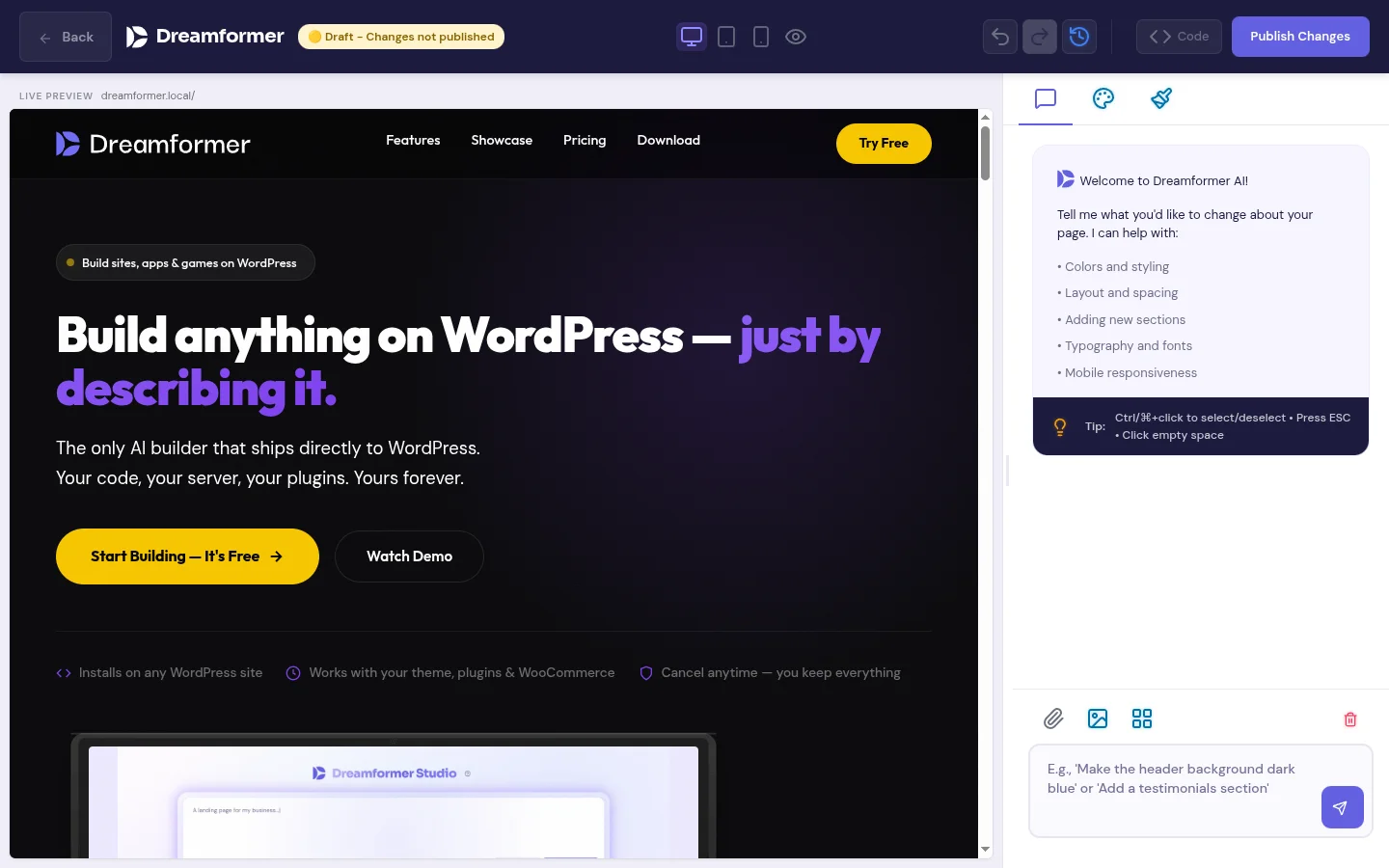
Open Dreamformer and describe what you want: “Create a product review site for home office equipment. Include a homepage with featured reviews, category pages for desks, chairs, and monitors, and individual review page templates with pros/cons and affiliate buttons.” The AI builds the entire site structure.
Add content and monetize
Write your first 5–10 product reviews or comparison posts. Add your affiliate links. Install an SEO plugin like Yoast (WordPress makes this easy). Use Dreamformer to generate additional pages as you expand into new product categories. Each new page is another potential traffic source.
Example: building a ghost commerce site for kitchen gadgets
Let us walk through a real example. Say you want to build a ghost commerce site reviewing kitchen gadgets — air fryers, knife sets, blenders, coffee machines. Here is what you would tell Dreamformer:
“Create a product review website for kitchen gadgets. I need a homepage with a hero section, featured product categories (air fryers, blenders, knife sets, coffee makers), and a ‘best of’ section. Add a review template page with a product image area, star rating, pros and cons list, a verdict section, and a prominent affiliate buy button. Style it clean and modern with a food/cooking feel.”
Dreamformer generates the complete site: homepage with category cards, individual review page templates, comparison table layouts, and styled affiliate buttons — all as real HTML, CSS, and JavaScript files on your WordPress site. You then fill in your actual product reviews, add your Amazon affiliate links, and publish.
From that starting point, you build out content over time. Each “best [product] for [use case]” page targets a specific search query. “Best air fryer for a family of 4” is a real query with real purchase intent. Someone searching that phrase is ready to buy — they just need a recommendation they trust. Your content provides that recommendation, your affiliate link earns the commission.
The compounding effect is what makes ghost commerce powerful: 10 review pages might generate 500 visitors per month. 50 pages might generate 5,000. At a 3% click-through rate on affiliate links and a 10% conversion rate on Amazon, that is 15 sales per month from 5,000 visitors. At an average order of $80 and a 6% commission, that is roughly $72/month — from a site that costs $0–$29/month to run. Scale to 200 pages and the math gets interesting.
Why WordPress is the best platform for ghost commerce
Ghost commerce lives or dies on SEO. WordPress gives you the tools to win.
SEO control
WordPress gives you full control over meta titles, descriptions, URL structure, schema markup, sitemaps, and page speed — everything that affects how Google ranks your content. Platforms like Wix and Squarespace limit these controls. With plugins like Yoast or Rank Math, WordPress is the strongest SEO foundation available.
Ownership
Your ghost commerce site is a business asset. On WordPress, you own the code, the content, the domain, and the data. You can switch hosts, sell the site, or migrate it anywhere. On proprietary platforms, you are renting — and if they change terms or raise prices, you lose everything you built.
Plugin ecosystem
WordPress has 60,000+ plugins. For ghost commerce specifically: WooCommerce for digital products, ThirstyAffiliates or Pretty Links for affiliate link management, TablePress for comparison tables, and Schema Pro for rich snippet markup. You get a full ghost commerce toolkit without writing code.
Common ghost commerce mistakes (and how to avoid them)
Ghost commerce has a low barrier to entry, which means a lot of people start and fail. Here are the mistakes that kill most ghost commerce sites before they gain traction:
Choosing a niche that is too broad. “Tech reviews” is not a niche. “Budget mechanical keyboards for programmers” is. The narrower your focus, the faster you build topical authority and the easier it is to rank. You can always expand later once you own your initial niche.
Thin, generic content. If your product reviews read like slightly reworded Amazon descriptions, you will not rank and visitors will not trust you. Write from experience, include real opinions (including negatives), and provide information that is not available on the product page itself. AI can help you generate the structure, but you need to add genuine expertise.
Ignoring site speed and design. Ghost commerce is a trust business. If your site looks unprofessional, loads slowly, or feels spammy, visitors bounce. A clean, fast WordPress site built with AI gives you a professional foundation from day one — which is why tools like Dreamformer exist.
Not disclosing affiliate relationships. FTC requires clear disclosure on every page that contains affiliate links. Add a disclosure statement to your site header or the top of every review post. This is non-negotiable — violations carry real penalties.
Expecting fast results. Ghost commerce is a content business, and content takes time to rank. Most new sites see meaningful organic traffic after 3–6 months of consistent publishing. If you need money next week, ghost commerce is not the right model. If you can invest 6 months of consistent effort, the compounding returns are real.
Essential tools for ghost commerce in 2026
Everything you need to launch, manage, and grow a ghost commerce business.
Ghost commerce FAQ
Yes. Ghost commerce is a legitimate business model. Affiliate marketing, content monetization, and curated storefronts are all legal and widely practiced. The key legal requirement is transparency: you must disclose affiliate relationships to your visitors (FTC guidelines in the US, similar regulations elsewhere). As long as you are honest about your business model and do not make false claims about products, ghost commerce is completely legal.
It depends entirely on your niche, content volume, and traffic. Realistic ranges: $0–$100/month in the first 3–6 months while building content and waiting for SEO to kick in. $500–$2,000/month after 6–12 months with consistent publishing in a decent niche. $5,000–$20,000+/month for mature sites with hundreds of pages and established authority. Some ghost commerce operators earn six figures annually, but that typically requires 1–2 years of sustained effort.
Not anymore. AI website builders like Dreamformer let you describe your site in plain English and get a complete, professional website built on WordPress. No coding, no design skills, no technical knowledge required. You need to learn the basics of SEO and content writing, but building the website itself is no longer a technical barrier.
Dropshipping involves processing orders, managing customer service, handling returns, and dealing with suppliers — you are a middleman in the transaction. Ghost commerce is one step further removed: you do not handle transactions at all. You create content that sends visitors to other sites where they purchase, and you earn a commission or ad revenue. Ghost commerce has lower margins but also lower operational complexity.
With an AI website builder, the initial site structure takes minutes — describe what you want and the AI generates it. Adding your first batch of content (10–15 product reviews or comparison posts) typically takes 1–2 weeks of focused work. The ongoing effort is content creation: plan to publish 2–4 new pieces per week to build momentum. The site itself is live from day one; the business grows as your content library grows.
You can use AI to generate site structure, page layouts, and first drafts — and tools like Dreamformer are built specifically for this. However, for product reviews and recommendations, you should add genuine expertise, personal experience, and honest opinions. Google’s helpful content guidelines reward content written by people with real knowledge. Use AI for structure and speed; add human expertise for credibility and rankings.
Build your ghost commerce site today. Start earning from content, not inventory.
Describe your niche. AI builds your WordPress site. You add the content that earns.
Start Building FreeFree plan includes 25 credits. No credit card required.